product selection
Refine a product scope by variant
Learn how to refine a product scope by variant with a safe Juniper & Trail example, shopper impact, options, and recovery checks. Refinement runs after the product scope. Keep all variants, match variant conditions, or hand-pick variant IDs without rebuilding the wider product scope.
Before you begin
- Organize Shopify titles, tags, vendors, types, collections, and inventory
- Identify products or variants that must never change
- Know whether future catalog items should join automatically
Keep the campaign in Draft while you verify the configuration. Use a private storefront window where the guide changes shopper-facing behavior.
Step-by-step setup
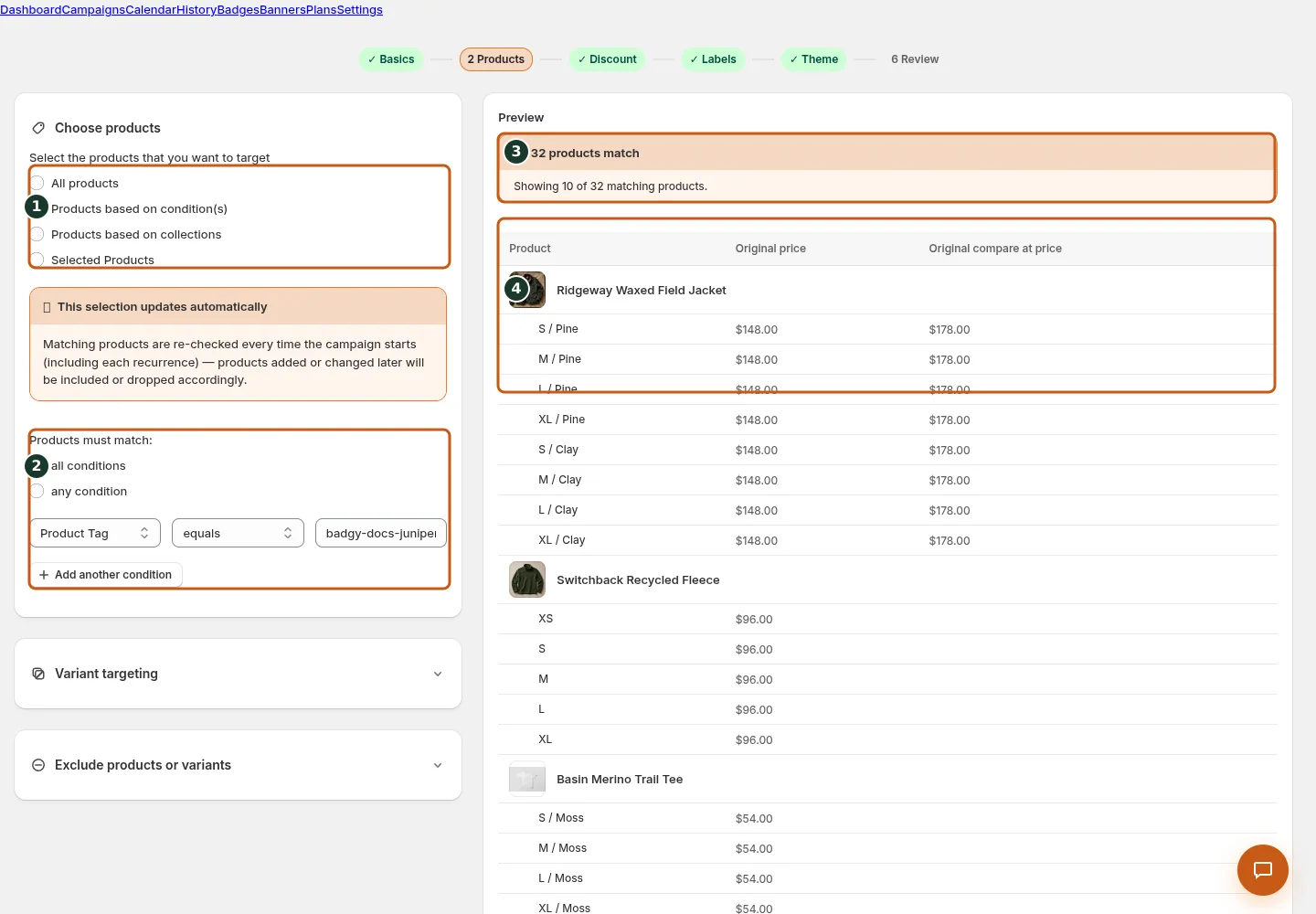
Choose all products, rules, collections, or a hand-picked selection.
Define the matching condition used to keep the selection current.
Confirm the number of matching products before continuing.
Inspect matching products, variants, and original prices in the preview.
- Choose the Stage 1 product scope.
- Expand Variant targeting (optional).
- Choose All variants, Match conditions, or Hand-pick variants.
- For conditions, choose independent All/Any logic and variant fields; for hand-pick, use the scope-constrained browser.
- Resolve any scope-changed warning and refresh Preview.
Refinement runs after the product scope. Keep all variants, match variant conditions, or hand-pick variant IDs without rebuilding the wider product scope.
Juniper & Trail example
Juniper & Trail uses refine a product scope by variant to include trail-ready products while protecting the Old Growth Logo Tee and sold-out variants with explicit exclusions. The documentation fixture uses realistic products, inventory states, variants, collections, and protected exclusions so the preview exercises the same decisions as a merchant catalog.
What shoppers will see
Only resolved variants receive campaign behavior; mixed products can show different variant prices or eligibility on the same product page. Check the relevant result from product through cart where applicable. For shopper-facing work, compare desktop and mobile and verify both an eligible and an ineligible item.
Common mistakes and troubleshooting
- Acting on the wrong shop. Confirm the Shopify store and campaign before following Refine a product scope by variant.
- Trusting a stale preview. Refresh after catalog, schedule, discount, theme, locale, or market changes.
- Repeating a background command. Read status and History first; retry only when Badgy presents a recoverable failure.
- Skipping the consequence check. Confirm what changes for shoppers and what the end or restore path will do.
If the status reports revoked authorization, reconnect Shopify before retrying. If the result still differs from the preview, preserve the campaign ID and approximate time, then open support from this identified shop. Never send customer data, access tokens, or full catalog exports in feedback.
Related guides
Options reference
| Option | Use it when | Consequence | | --- | --- | --- | | All variants | Keep full scoped products | No refinement | | Match conditions | Dynamic SKU, price, inventory, weight, or option rules | Own All/Any logic | | Hand-pick | Fixed exact variants | Picker constrained by scope |
Badgy behavior in this guide is reviewed against the repository's shipped UI, service rules, and feature design documents. Shopify-owned theme, Markets, Flow, billing, and discount behavior can also depend on the store's Shopify configuration; consult the Shopify Help Center for that platform configuration.