discounts pricing
Build volume discount tiers
Learn how to build volume discount tiers with a safe Juniper & Trail example, shopper impact, options, and recovery checks. Volume tiers are function-backed. Define ascending quantities and a reward for each rung; a NONE row can display the standard-price anchor without granting a discount.
Before you begin
- Choose the shopper behavior: visible price, code, quantity tiers, or BOGO
- Confirm eligible products and markets
- Define the intended revert outcome
Keep the campaign in Draft while you verify the configuration. Use a private storefront window where the guide changes shopper-facing behavior.
Step-by-step setup
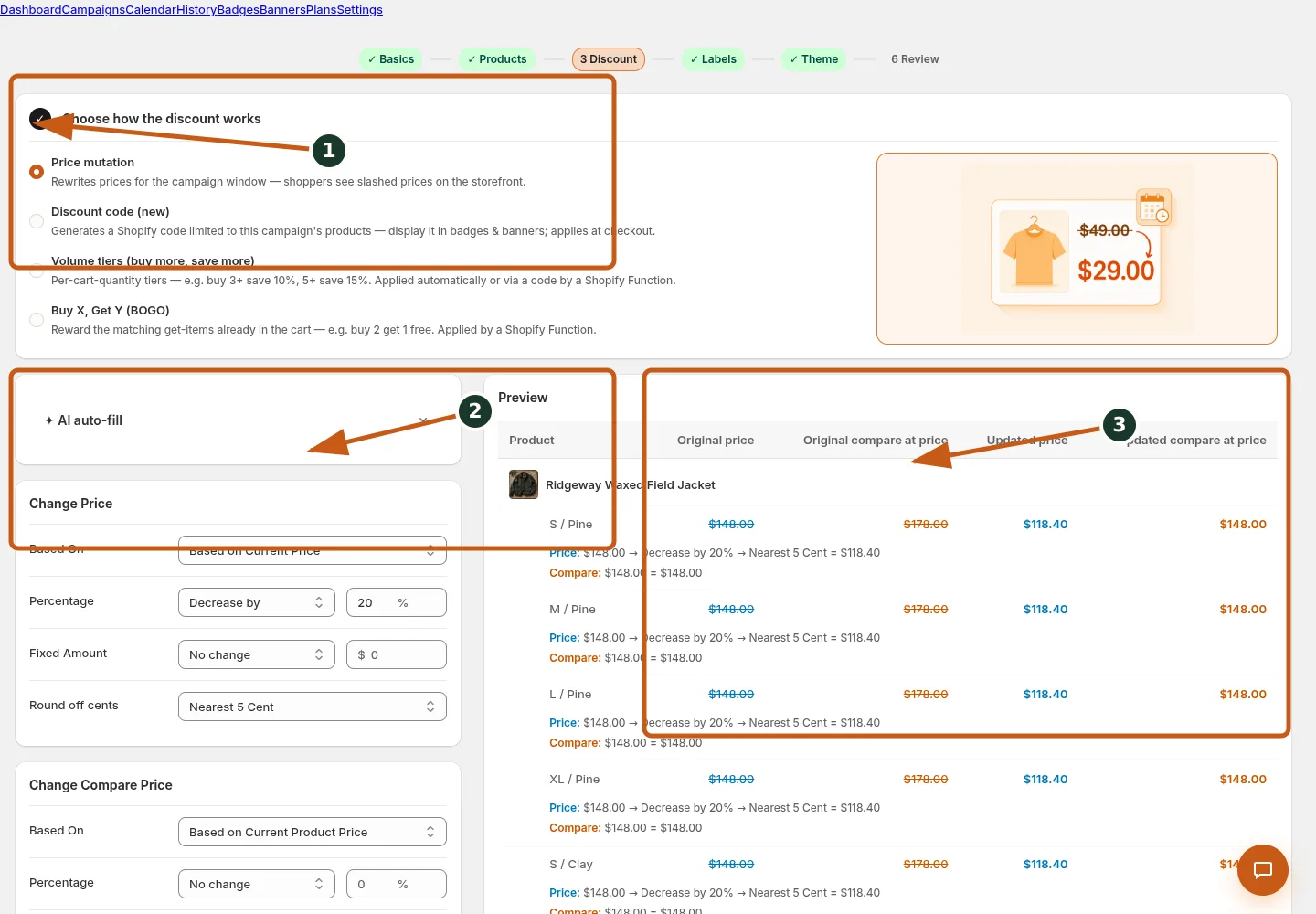
Select the discount route that matches the promotion.
Set the price base, percentage operation, amount, and rounding behavior.
Verify updated prices and compare-at prices for real Juniper & Trail variants.
- Choose Volume discount and edit the Tier Deals ladder.
- Set ascending Minimum quantity values; the highest qualifying threshold wins for each cart line.
- Choose each row type: None, Percentage, Fixed amount, Target price for eligible single-product campaigns, or BOGO where offered.
- Mark one Best value if useful, arrange rows, and preview the upsell block.
- Choose Automatic at checkout or Discount code; enter a code when selected, then validate cart quantities.
Volume tiers are function-backed. Define ascending quantities and a reward for each rung; a NONE row can display the standard-price anchor without granting a discount.
Juniper & Trail example
Juniper & Trail tests the workflow for Build volume discount tiers on the Alder 18L Daypack and Roam 750 Steel Bottle. The team checks the product, cart, and restore consequences before launch. The documentation fixture uses realistic products, inventory states, variants, collections, and protected exclusions so the preview exercises the same decisions as a merchant catalog.
What shoppers will see
The cart outcome depends on the route: direct price changes catalog prices, while code and function-backed offers are calculated by Shopify when eligibility is met. Check the relevant result from product through cart where applicable. For shopper-facing work, compare desktop and mobile and verify both an eligible and an ineligible item.
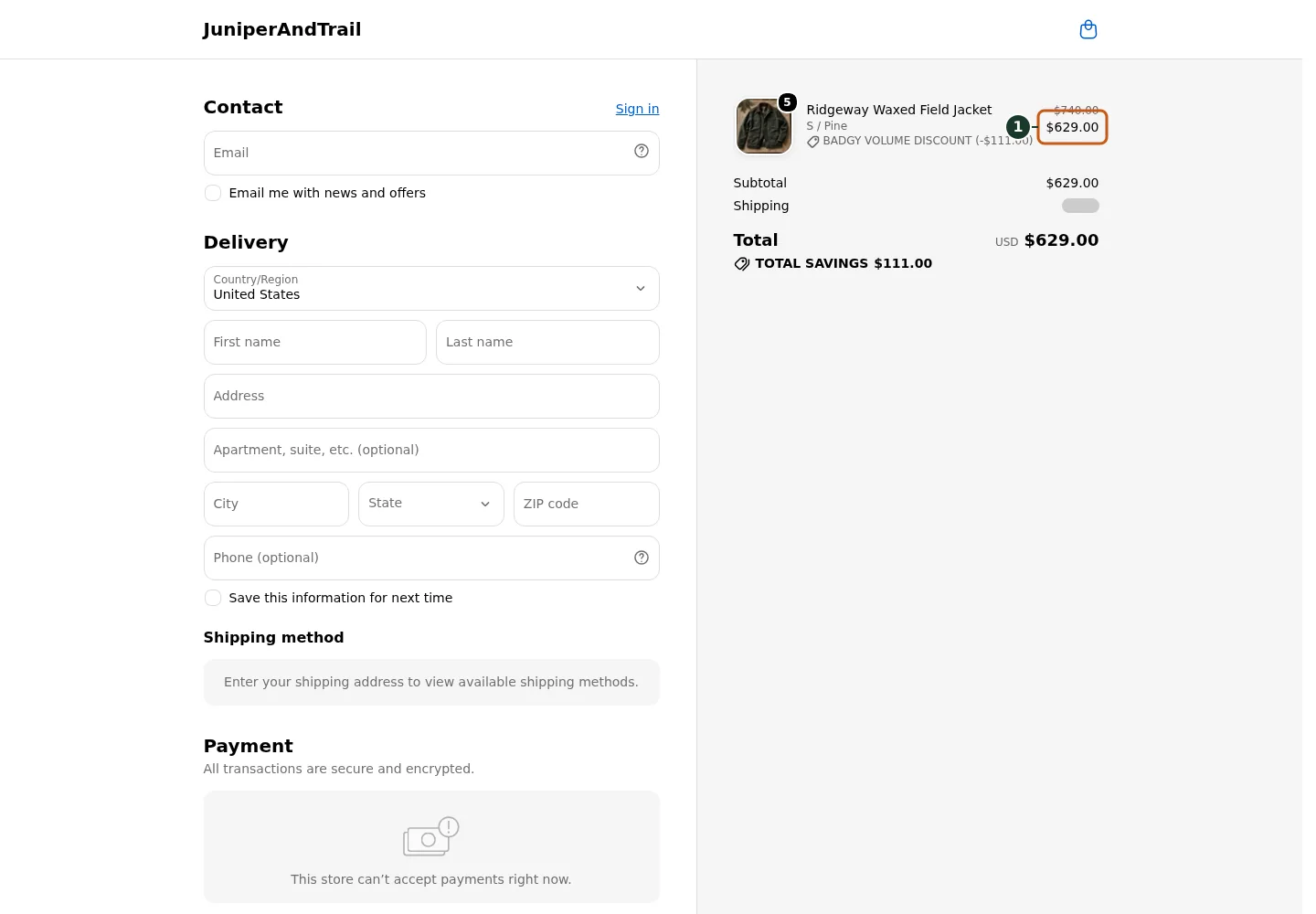
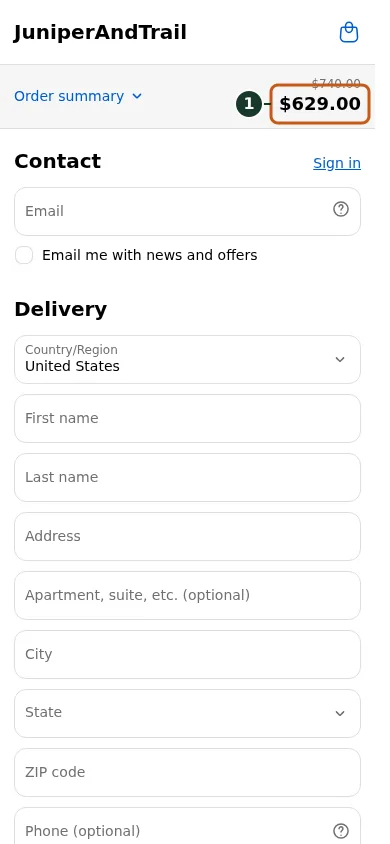
- Confirm the five-unit cart shows the 15% tier and a $629 final total.
Common mistakes and troubleshooting
- Acting on the wrong shop. Confirm the Shopify store and campaign before following Build volume discount tiers.
- Trusting a stale preview. Refresh after catalog, schedule, discount, theme, locale, or market changes.
- Repeating a background command. Read status and History first; retry only when Badgy presents a recoverable failure.
- Skipping the consequence check. Confirm what changes for shoppers and what the end or restore path will do.
If the status reports revoked authorization, reconnect Shopify before retrying. If the result still differs from the preview, preserve the campaign ID and approximate time, then open support from this identified shop. Never send customer data, access tokens, or full catalog exports in feedback.
Related guides
Options reference
| Option | Use it when | Consequence | | --- | --- | --- | | None | Display standard-price anchor | Grants no discount | | Percentage / Fixed | Reward qualifying line quantity | Highest threshold wins | | Target price | Set total for rung | Single-product campaigns only | | Automatic | No code entry | Function applies at checkout | | Discount code | Code-delivered tiers | Code must be communicated |
Badgy behavior in this guide is reviewed against the repository's shipped UI, service rules, and feature design documents. Shopify-owned theme, Markets, Flow, billing, and discount behavior can also depend on the store's Shopify configuration; consult the Shopify Help Center for that platform configuration.